
End-of-Life IT Hardware: How to Safely Dispose of Business Equipment in Ireland
- Kamran Hussain
- 3 days ago
- 6 min read

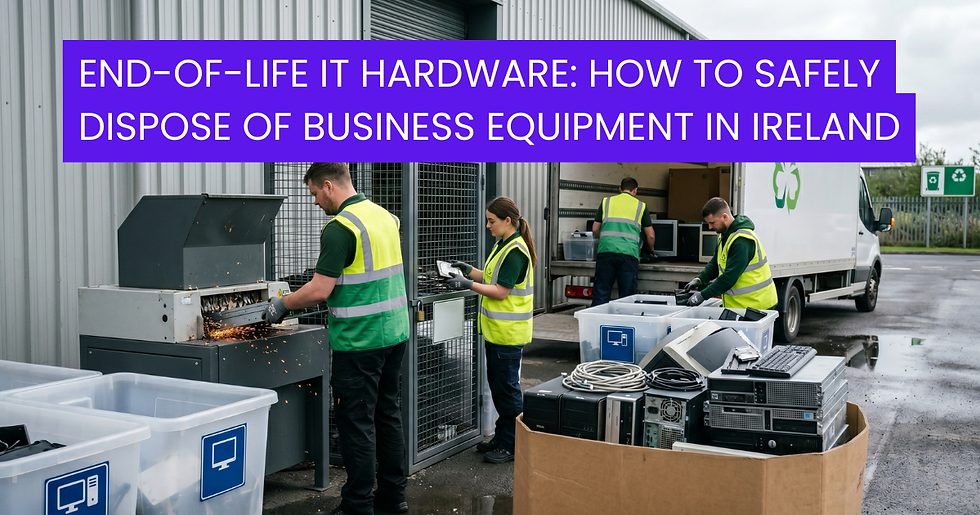
The old laptops are in a cupboard. The dead server is under someone's desk. There's a box of retired phones nobody wants to deal with. Sound familiar?
Almost every business in Ireland has a quiet graveyard of retired IT kit somewhere on the premises, and most of it is sitting there for the same reason: getting rid of it properly feels like a hassle, and nobody's quite sure what the rules are. So it waits. The trouble is that every one of those devices is two problems in one. It's a pile of sensitive data that hasn't really been deleted, and it's electronic waste you're legally responsible for handling correctly.
Tossing it in a skip isn't an option, and a quick factory reset doesn't make a hard drive safe. Let's walk through what end-of-life actually means for business hardware in Ireland, what the law expects of you, and how to clear that cupboard without creating a bigger problem than the one you started with.
End-of-life is a stage, not an event
A device doesn't fail all at once. It ages out. Performance slips, the warranty lapses, security updates stop arriving, and at some point it's costing you more to keep than to replace. Working out when you've reached that point is its own decision, and we covered the framework for it in our guide to server lifecycle management and when to upgrade versus replace.
But deciding to retire a machine is only the first half. The second half, the part that gets neglected, is what happens to it next. A retired device still holds everything it ever stored, and it's still your responsibility until it's been disposed of properly. End-of-life isn't the moment you stop using something. It's the process of getting it safely out of your business.
The data problem nobody takes seriously enough
Here's the misunderstanding that catches businesses out. Deleting files or running a factory reset feels like wiping the slate clean. It isn't.
When you delete a file, the operating system just marks that space as available. The actual data sits there until something writes over it, and readily available recovery tools can pull it back. Customer records, employee details, financial information, emails, contracts. All of it can be recovered from a drive that looks empty. For a business, that's not a tidiness issue, it's a data protection one.
Under GDPR, you're responsible for personal data through its entire life, and that includes the moment you dispose of the device holding it. A retired laptop that ends up in the wrong hands with recoverable client data on it is a breach, with everything that follows: notification obligations, potential penalties, and the reputational damage that's often worse than the fine. The Data Protection Commission treats improper disposal as seriously as any other breach.
Proper data destruction means one of two things. Either certified data erasure, which uses specialist software to overwrite a drive so thoroughly that nothing can be recovered, or physical destruction, where the drive is shredded into fragments. Both should come with documentation proving it was done. Which brings us to the piece of paper that matters most.
Why the certificate of destruction is the bit that matters
If you take one practical thing from this article, make it this: when a third party disposes of your equipment, you need a certificate of destruction for it.
That certificate, ideally serialised down to individual asset level, is your proof. It's the audit trail that shows you met your GDPR obligation and your environmental one. If a question is ever raised about where a device went or whether its data was destroyed, that paperwork is the difference between "here's our documented process" and an uncomfortable silence. A reputable disposal partner provides this as standard. If a service won't give you one, that tells you what you need to know about the service.
The WEEE rules, and the commercial catch that trips businesses up

The second obligation is environmental. IT equipment is classed as Waste Electrical and Electronic Equipment, governed in Ireland by the WEEE regulations that flow from the EU's WEEE Directive (2012/19/EU). The principle is straightforward: electronics shouldn't go to landfill, because they contain hazardous materials like lead and mercury alongside valuable recoverable ones like gold and copper. They have to be collected, treated, and recycled through authorised channels.
Now, the catch. You might know that household WEEE can be dropped at your local recycling centre free of charge. Here's what surprises people: most council recycling centres do not accept commercial WEEE. Equipment used in a business setting, servers, large printers, office gear, falls outside the household route. WEEE Ireland's own guidance points businesses toward their supplier or a licensed waste contractor instead, naming operators such as KMK Metals Recycling and Wisetek. So the skip is illegal, and the local recycling centre often won't take it either. The correct path is a licensed contractor or a supplier who manages it for you.
This is one of those areas where assuming the household rules apply to your business is an easy and genuinely risky mistake.
Don't write off the value too quickly
Not everything at end-of-life is waste. This is the part businesses most often miss.
Plenty of retired kit still has working life and resale or reuse value. A three-year-old fleet of business laptops, properly wiped and graded, can be refurbished and put back into service rather than destroyed. That's better for your budget and far better environmentally, since the greenest device is usually the one that doesn't have to be manufactured from scratch. We made the wider case for this in our look at refurbished versus new IT hardware for Irish B2B buyers.
The key is that reuse and secure data destruction aren't in conflict. A good process wipes every device to a certified standard first, then decides what gets refurbished and what gets recycled. You get the environmental and financial upside without ever compromising on data security. The order matters: destroy the data, then recover the value.
What a sensible disposal process actually looks like
You don't need to overthink this. A clean end-of-life process for a business runs roughly like this.
Keep a record of what you're retiring, so you know exactly which assets left and when. Make sure anything you still need is backed up before the device goes anywhere. Then hand the equipment to a provider who collects it, destroys the data to a certified standard, and gives you serialised documentation for every unit. From there, working kit is refurbished or resold and the rest is recycled through authorised WEEE channels, with the environmental side handled and logged.
The thing that makes all of this painless is dealing with someone who treats hardware as a whole lifecycle rather than a one-off sale, the same partner who helped you buy it sensibly in the first place. We set out that whole approach in our complete B2B IT hardware buying guide for Ireland, and disposal is simply the last chapter of it. When procurement and end-of-life are managed by the same partner, nothing falls through the cracks.

Clear the cupboard, properly
That pile of old equipment isn't going to deal with itself, and the longer it sits there, the longer your old data sits there with it. The good news is that handled correctly, end-of-life disposal is quick, compliant, and often recovers more value than you'd expect.
If you've got retired laptops, servers, or office hardware you need gone safely, talk to the DataDirect team. We help businesses across Ireland retire equipment the right way, with certified data destruction, proper WEEE recycling, and the documentation to prove both. We can also help you plan replacements from our business IT hardware range so your refresh and your disposal are handled together. For more practical guides on getting IT right, have a look through the DataDirect blog.
Frequently Asked Questions
How do I dispose of old business IT equipment in Ireland? You can't put commercial IT equipment in a skip or, in most cases, a council recycling centre, since those handle household WEEE only. The correct route is a licensed waste contractor or an IT supplier who manages secure disposal for you, ensuring data is destroyed and the hardware is recycled through authorised WEEE channels. Always get documentation confirming it was done.
Is a factory reset enough to delete business data before disposal? No. A factory reset or file deletion only marks the space as reusable, and the underlying data can often be recovered with freely available tools. Proper protection requires certified data erasure that overwrites the drive, or physical destruction such as shredding. For business data under GDPR, that distinction matters a great deal.
Do businesses have to recycle IT equipment by law in Ireland? Yes. IT equipment is Waste Electrical and Electronic Equipment, covered by Ireland's WEEE regulations and the EU WEEE Directive, which require it to be collected and recycled through authorised channels rather than sent to landfill. Businesses are responsible for ensuring their commercial WEEE is handled by a licensed operator.
What is a certificate of data destruction and why do I need one? It's documentation from your disposal provider confirming that the data on each device was securely destroyed, ideally listed by individual asset. It's your audit trail proving you met your GDPR and environmental obligations if anyone ever asks. A reputable provider issues one as standard; treat its absence as a red flag.
Can DataDirect handle our end-of-life IT disposal for us? Yes. We help businesses across Ireland retire equipment securely, with certified data destruction, authorised WEEE recycling, and full documentation, and we can recover value from kit that still has working life. Get in touch with our team and we'll arrange collection and handle the process end to end.


Comments