
Real World Deployments
Case Studies Across Every Sector
From NHS hospitals to Royal Navy carriers, manufacturing floors to harbour estates — see how DataDirect Intelligence delivers measurable outcomes where tracking complexity is highest.
Real Deployments. Real Results.
Healthcare
£361k ↓
in annual staff search time at NHS Wales health board
Pharma
480% ROI
on T34 syringe driver tracking within 7 months
Defence
6hrs ↓
Emergency muster time — down to 4.5 mins on Royal Navy carriers
Manufacturing
25% ↓
in seek time during manufacturing kitting
Transforming asset visibility across NHS Wales

NHS Wales — University Health Board
Transforming Asset Tracking Across Hospitals and Community Care
480%
ROI within 7 months
£198k
3-year saving on device replacement
50%+
Of devices previously unaccountable at any time
The Challenge
The University Health Board could not account for more than 50% of its 200 T34 syringe drivers — critical devices used to manage end-of-life medication in the community — at any given time. As patients moved to family homes, residential care, or passed away, devices were lost with no mechanism to retrieve them. At £2,000 per unit, the board was purchasing 40 replacement devices annually just to maintain operational capacity, with over £240,000 in replacement costs projected over three years. Manual processes made community locating impossible.
The Solution
- GPS tracking deployed on all 200 T34 syringe drivers
- Real-time visibility of device location as they move from hospital into community settings
- Automated alerts when devices become stationary or move outside expected areas
- Community locating workflows enabling timely retrieval from patients' homes and care settings
- Digital audit trail of device movement, servicing history, and redistribution
The Outcome
- 480% return on investment achieved within 7 months of deployment
- £198,656 saved over 3 years through eliminated replacement purchasing
- Annual replacement purchasing of 40 units reduced to near zero
- Board able to account for and retrieve devices across all community settings
- Positive impact on annual CAPEX with ongoing savings compounding year-on-year
“There was a feeling that nurses and porters spend a lot of time in hospitals looking for equipment, which is impacting patient discharge and patient care. DataDirect Intelligence were appointed because they really understood what the project was looking to achieve — and proposed a financial model based on zones rather than tags, making it scalable from the outset.”
Helen Northmore — Head of Innovation Adoption (Digital & AI), NHS Wales

Royal Glamorgan Hospital — Cwm Taf Morgannwg University Health Board
Recovering £361k in Annual Staff Time Lost to Equipment Searching
58%
ROI achieved within 8 months
£361k
Annual cost of staff search time recovered
£1,077
Daily cost of equipment searching across departments
The Challenge
Across the 12,000-employee health board, clinical staff at every level — from Band 2 porters to Band 6 nurses and clinical engineers — were spending hours every shift searching for medical devices. Porters logged up to 4 hours daily, clinical engineers up to 7. Aggregated across departments, this amounted to £1,077 every single day — £361,843 annually — in wasted salary on equipment hunting alone. Devices going unfound delayed patient treatment, created MHRA compliance gaps, and drove unnecessary CAPEX spend when equipment that existed simply couldn't be located.
The Solution
- RFID tags deployed on medical devices across all departments and wards
- Real-time equipment location dashboard accessible to all ward staff and clinical engineers
- 40 fixed read zones covering A&E, X-ray, and key wards with readers at entry, exit, and corridor points
- Direction-of-travel detection to pinpoint equipment movement between zones
- Zone-based pricing model — scaled by location coverage, not tag volume, for a cost-controlled rollout
The Outcome
- 58% ROI delivered within 8 months of deployment
- £361,843 in annual staff search time recovered and redirected to patient care
- £30,154 monthly saving in wasted salary costs across nursing, portering, and clinical engineering
- MHRA compliance and device audit capability restored through real-time location data
- Technology adopted permanently and expanded across additional health board sites
“DataDirect Intelligence were appointed because they really understood what the project was looking to achieve in terms of trialling the technology and assessing its impact. They proposed a different financial model, basing the costings around the number of zones in the hospital rather than the number of tags — making the project scalable and allowing us to understand exactly what we could test during the pilot.”
Helen Northmore — Head of Innovation Adoption (Digital & AI), NHS Wales
Real-time personnel accountability aboard the UK's largest warships

Royal Navy — HMS Queen Elizabeth & HMS Prince of Wales
4.5 min
Muster time — down from 6 hours
1,700
Souls on board tracked across 8,000 compartments
The Challenge
Royal Navy vessels operate in extremely hazardous environments with crews numbering into the thousands — yet the standard method for accounting for all souls on board was a manual peg in/out board. On the Queen Elizabeth class carriers, each with up to 1,700 crew and visitors spread across 8,000 internal compartments, this system was inadequate for safety, unfit for emergencies, and provided no digital audit trail. In 2019, the Royal Navy and DASA launched the Get the Ship in Shape competition to find a modern, reliable Personnel Accounting System (PAS) capable of replacing it.
The Solution
- Network of ruggedised deckhead and bulkhead-mounted terminals at all ingress, egress, and high-traffic locations throughout both carriers
- Crew tap their ID card at any terminal to record entry, exit, and location — similar to a train station gate
- Visitors issued dedicated cards for full arrival, departure, and movement traceability
- Live web-based dashboard showing all souls on board in real time, accessible from any terminal device
- Emergency muster function enabling rapid headcount at any location on the vessel
The Outcome
- Muster time reduced from 6 hours to 4.5 minutes — a critical improvement to safety in emergency scenarios
- Trialled on HMS Bristol, then both HMS Queen Elizabeth and HMS Prince of Wales — subsequently procured by the Royal Navy for permanent use on both carriers
- Used as the primary accounting method during HMS Queen Elizabeth's global CSG21 deployment in 2021
- Managed all delegates at the 2021 Pacific Future Forum hosted aboard HMS Prince of Wales
- Technology identified for potential expansion to energy, nuclear, prison, and blue light service sectors
“The PAS project has exceeded expectations. This capability is now providing positive evidence that technology can reduce the Risk to Life of Souls on Board — and it was used as the primary accounting method on HMS Queen Elizabeth for her global deployment in 2021. To achieve this success on a strategic defence platform in a highly demanding environment is remarkable for any project; to get this far from a tech demonstration so quickly is unheard of, and has been the result of solid collaboration across defence organisations and supplier.”
Lieutenant Will Thomas — Capital Ships Weapon Engineer, Royal Navy & Project Sponsor
Reducing seek time and driving output efficiency on the production floor
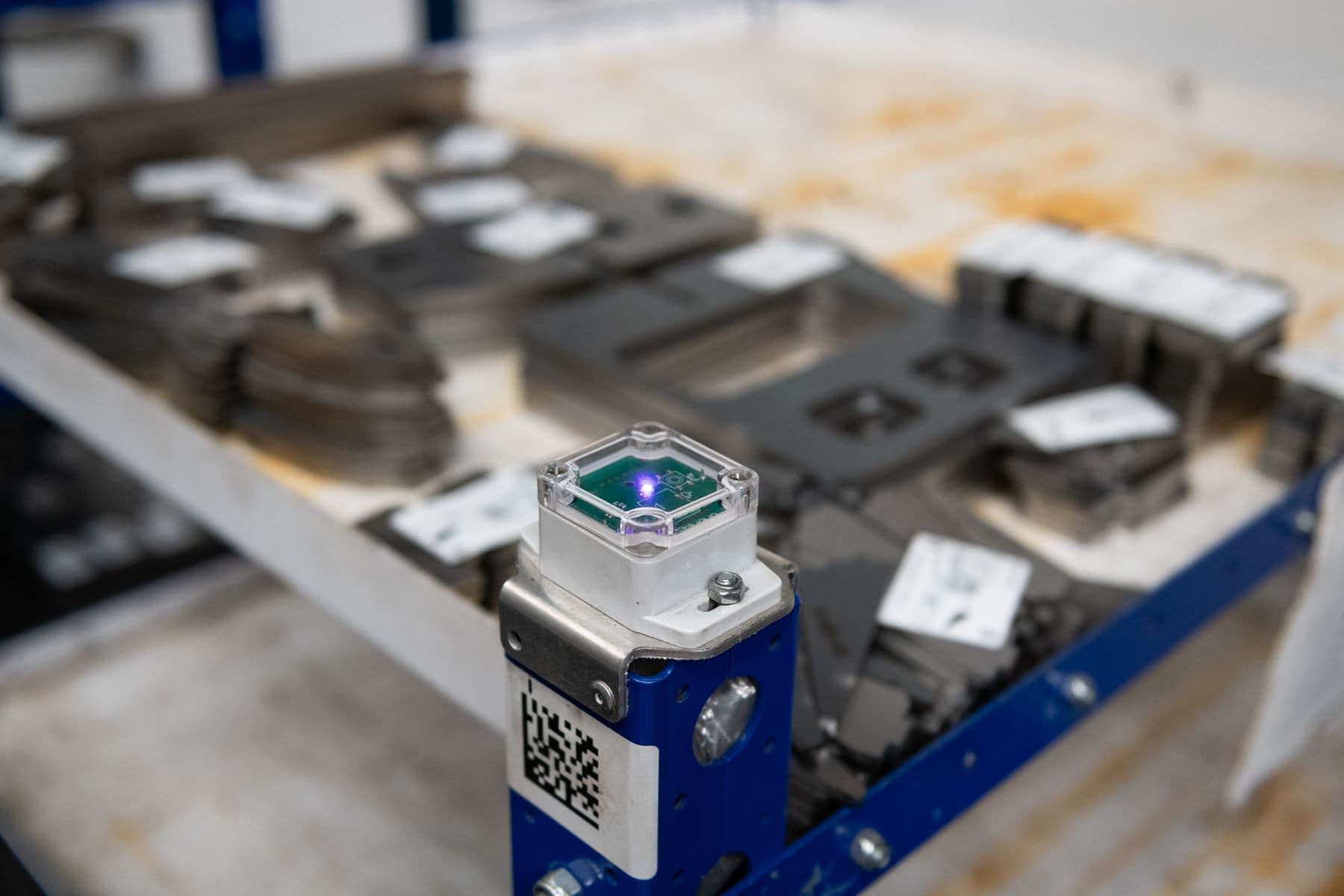
Hutchinson — High-Integrity Metal Fabrications
Transforming Engineering Production Efficiency with Real-Time Asset Tracking
20%
Reduction in seek time during kitting
£49k
Cost savings in kitting process alone
7.5%
Projected output increase per head over 12 months
The Challenge
Hutchinson designs and manufactures high-integrity metal fabrications across multiple indoor and outdoor sites. Teams were spending significant time locating Work-in-Progress trolleys for daily kitting activities — delays at this stage created downstream backlogs throughout production. With no real-time visibility across sites, the company also needed a solution that could lay the foundation for future automation and Industry 5.0 practices.
The Solution
- High-accuracy BLE sensors with sub-metre (60cm) tracking across all production zones
- LED indicators to flash and locate trolleys instantly across large areas
- Automated alerts when trolleys enter or exit defined production zones
- Rules-based workflow automation notifying teams as production progresses
- 2D digital twin of the factory floor for accurate zone mapping
The Outcome
- 25% reduction in seek time during kitting activities
- £49,000 cost savings in kitting process alone
- 7.5% projected output increase per head over 12 months
- Real-time component traceability across all sites
- Foundation established for broader automation and Industry 5.0 practices
“Working with DataDirect Intelligence to implement BLE tagging on our trolleys has been a real game changer. We can now track components in real time and know exactly where everything is at any moment in the process. This level of traceability doesn't just streamline operations — it transforms how we update our customers.”
Richard Hutchinson — Head of Innovation, Hutchinson
Data-driven decisions for healthier communities

Belfast Harbour Estate
Air Quality Monitoring Across a Major Port Estate
6%
Pollutants monitored in real time
24/7
Continuous cloud-based data capture
2030
Net zero goal — tracking progress with real emissions data
The Challenge
Belfast Harbour needed to establish a reliable baseline of air quality data across its estate to support long-term environmental and sustainability commitments. With no existing monitoring infrastructure, the harbour had no visibility of pollutant levels and no data to guide decision-making or demonstrate progress to regulators and the local community. The COVID-19 pandemic — and its temporary reduction in emissions — created a rare and time-limited opportunity to capture that baseline.
The Solution
- Network of advanced solar-powered air quality sensors at key estate locations
- Continuous monitoring of NO₂, NO, O₃, PM1, PM2.5, and PM10 pollutants
- Real-time cloud-based data capture with no manual intervention required
- Interactive dashboard for trend analysis, reporting, and data-driven decisions
- Scalable infrastructure aligned to Belfast Harbour's long-term sustainability goals
The Outcome
- First-ever air quality baseline established across the Belfast Harbour estate
- Ongoing real-time visibility into pollutant levels and environmental trends
- Data-driven capability to identify pollution sources and track improvements
- Supports regulatory compliance and public accountability on air quality
- Continuous emissions data underpinning Belfast Harbour's net zero 2030 goal — measuring progress against baseline year-on-year
“DataDirect Intelligence's system enabled Belfast Harbour to monitor air pollution, track changes over time, and make data-driven decisions to improve air quality across the estate — contributing to a healthier environment for the local community and supporting our long-term sustainability goals.”
Belfast Harbour — Estate Management
Ready to see what's possible in your sector?
Talk to our team about a deployment tailored to your environment and operational challenges.