
How Operations Managers Use Signal to Make Faster, Smarter Decisions
- Kamran Hussain
- 7 days ago
- 6 min read

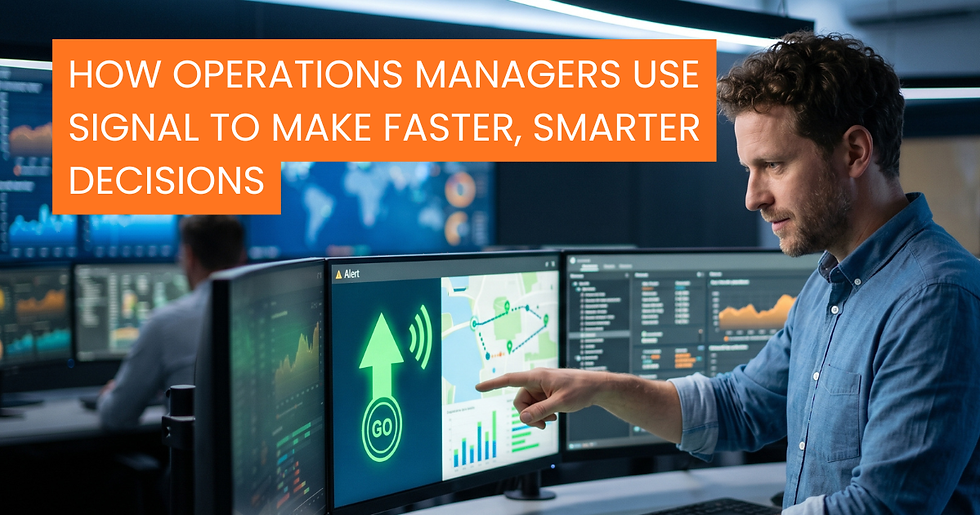
Every operations manager in Ireland knows the feeling. A delivery is late, and no one can say where the lorry is. A piece of equipment has gone missing on site. A customer is on the phone asking for an update, and the answer lives in three different spreadsheets, two WhatsApp threads, and one engineer's head.
This is not a technology problem. It is a visibility problem.
When the information you need is scattered across systems, sites, and team members, decisions get slower. Costs creep up. Small issues quietly turn into big ones. And by the time you have the full picture, the moment to act has already passed.
That is the problem Signal was built to solve. As part of the wider DataDirect Intelligence platform, Signal pulls live activity from across your operation — assets, vehicles, equipment, customer touchpoints — and turns it into something useful: a real-time view of what is happening, right now, with the context you need to act on it.
Below, we look at how operations managers across Ireland are actually using Signal day-to-day, and why a few of them say they wouldn't run their week without it.
What is Signal, in plain English?
Signal is a real-time intelligence layer. It sits on top of your assets, IoT devices, and business systems, captures the events that matter, and pushes them to your team as live, actionable insight.
Think of it less as a dashboard and more as a heartbeat for your operation. Where a traditional report tells you what happened last week, Signal tells you what is happening this second — and what to do about it.
For operations managers, that shift from retrospective to real-time is where the value lives.
1. Knowing where your assets are, without asking
Most operations teams in Ireland still rely on people to know where things are. The forklift is "probably in yard two." The diagnostic unit is "with Mick, I think." The pallet shipped on Tuesday is "in transit somewhere."
Signal removes the guessing. Every tagged asset reports its location, status, and movement in real time. When a manager opens the dashboard, they see the full picture: what is where, who has it, and whether it is being used.
The knock-on effects are bigger than they first appear. Less time spent searching means more time on the actual job. Fewer duplicate purchases because nobody can find what is already on site. And a cleaner audit trail when a regulator, auditor, or insurance provider asks for one.
This is particularly powerful in regulated sectors. Healthcare, defence, manufacturing, and logistics teams use Signal across these use cases precisely because the cost of not knowing is so high.
2. Catching problems before they escalate
Operations managers spend a disproportionate amount of their week firefighting. Equipment fails. Deliveries miss windows. A cold chain breaks. By the time the issue reaches the manager's inbox, the damage is usually done.
Signal flips that sequence. By monitoring conditions continuously, temperature, location, usage, downtime, deviations from expected behaviour, it alerts the right person the moment something goes off-track. Not in tomorrow's report. Not in the weekly review. Now.
For a logistics team, that might be a temperature-controlled shipment trending warm on the M50. For a manufacturer, it could be a piece of plant equipment running outside its normal pattern, suggesting maintenance is needed. For a healthcare provider, it might be a portable device that has been moved outside an authorised area.
In each case, the alert is not the value. The time saved by getting the alert early is the value.
3. Making decisions with current data, not last month's
Most operations decisions are still made from monthly reports. By the time the numbers are pulled together, validated, and presented, the period they describe is already over. The manager is steering by looking in the rear-view mirror.
Signal changes the time horizon. When live data is at hand, decisions move from quarterly reviews into daily standups. Should we reallocate that crew? Is this route consistently slow? Are we paying for assets we are not actually using? Each of these becomes answerable in minutes rather than weeks.
Irish SMEs and enterprises alike are using this shift to compress decision cycles, particularly when budgets are tight and every euro of operational waste matters.
4. Giving the team — not just the manager — the same view
A subtle but important benefit of real-time intelligence is what it does for the rest of the team.
When everyone is working off the same live data, the operations manager stops being a bottleneck. Site supervisors, drivers, technicians, and admin staff can all see the relevant slice of the picture for their role. Decisions get pushed closer to where the work happens, which is almost always faster and better.
That is why Signal is increasingly used as a shared operating system for ops teams in Ireland, rather than a tool that lives only on one manager's screen.
5. Building a defensible audit trail
Compliance is not optional. Whether you are dealing with HSA inspections, HSE audits, ISO certifications, or sector-specific regulators, the question is always the same: can you prove what happened, when, and who handled it?
Signal logs the events automatically. Location histories, asset movements, condition data, and access records are captured as they happen and stored in a structured, queryable way. When an auditor asks for evidence, the answer is a few clicks rather than a few days of digging.
For Irish businesses operating across regulated industries, and increasingly for those exporting into the EU and UK, this kind of traceability is becoming a baseline expectation, not a bonus.
What Signal does not replace

It is worth being honest here. Signal is not a magic wand. It does not replace good judgment, experienced operations managers, or the human relationships that hold a supply chain together.
What it does is take the cognitive load off the manager. Instead of holding twenty things in your head and hoping nothing slips, the system holds them for you and surfaces the ones that need your attention. The result is the same person making better, calmer, more informed decisions — not a different person, and not no person at all.
Getting started with Signal
If your operation has more visibility gaps than you would like, the practical next step is short.
Start by mapping out the three or four blind spots that cost you the most time each week. These are usually the things you have to ring someone to ask, or the things that only become a problem after the fact. That short list is the brief for what a real-time platform needs to solve first.
From there, the team at DataDirect can walk you through how Signal and the wider Intelligence platform would map onto your specific setup. There is no commitment in the conversation; it is mostly a question of whether the fit is right.
You can book a call with the team directly, or have a look through the use cases to see how businesses similar to yours are already running with it.
For broader IT, hardware, and software needs around your operation, the wider DataDirect catalogue is worth a browse. Signal sits alongside the hardware and software stack we supply to businesses across Ireland.
Frequently Asked Questions
What does Signal actually do for an operations manager?
Signal gives you live visibility of what is happening across your assets, sites, and operations in real time. It captures events as they occur, surfaces the ones that need attention, and lets you act before they turn into problems. For most operations managers, the day-to-day benefit is fewer phone calls to find out where things are and faster decisions when something changes.
Is Signal suitable for SMEs, or only large enterprises? Both. DataDirect works with SMEs and larger enterprises across Ireland, and Signal is deployed at both ends of that spectrum. The scope of the rollout adjusts to the size of the operation — there is no minimum scale at which it starts to make sense.
What industries in Ireland use Signal the most?
Healthcare, defence, manufacturing, logistics, and public sector teams are the heaviest users today. You can read more on the use cases page. That said, any operation with physical assets, time-sensitive deliveries, or compliance requirements tends to benefit.
How long does it take to get Signal up and running?
It depends on the number of assets and the integrations required, but most pilots are live within a few weeks. DataDirect handles the setup, the hardware, and the configuration as part of the engagement.
Does Signal replace our existing systems?
No. Signal sits alongside the systems you already use, ERPs, fleet tools, and asset registers, and adds the real-time layer they typically lack. The aim is to make your existing stack more useful, not to rip and replace it.
Is the data secure and compliant with Irish and EU regulations?
Yes. DataDirect operates from Dublin and structures all deployments to align with GDPR and the relevant sector-specific compliance requirements in Ireland and across the EU.
How do I find out if Signal is right for my operation? The fastest route is to book a short call with the DataDirect team. We will walk through your current setup, the gaps you are trying to close, and whether Signal is a sensible fit, straight answer, no pressure.


Comments